How Hair Grows: The Hair Cycle: How It Works, Explained Simply
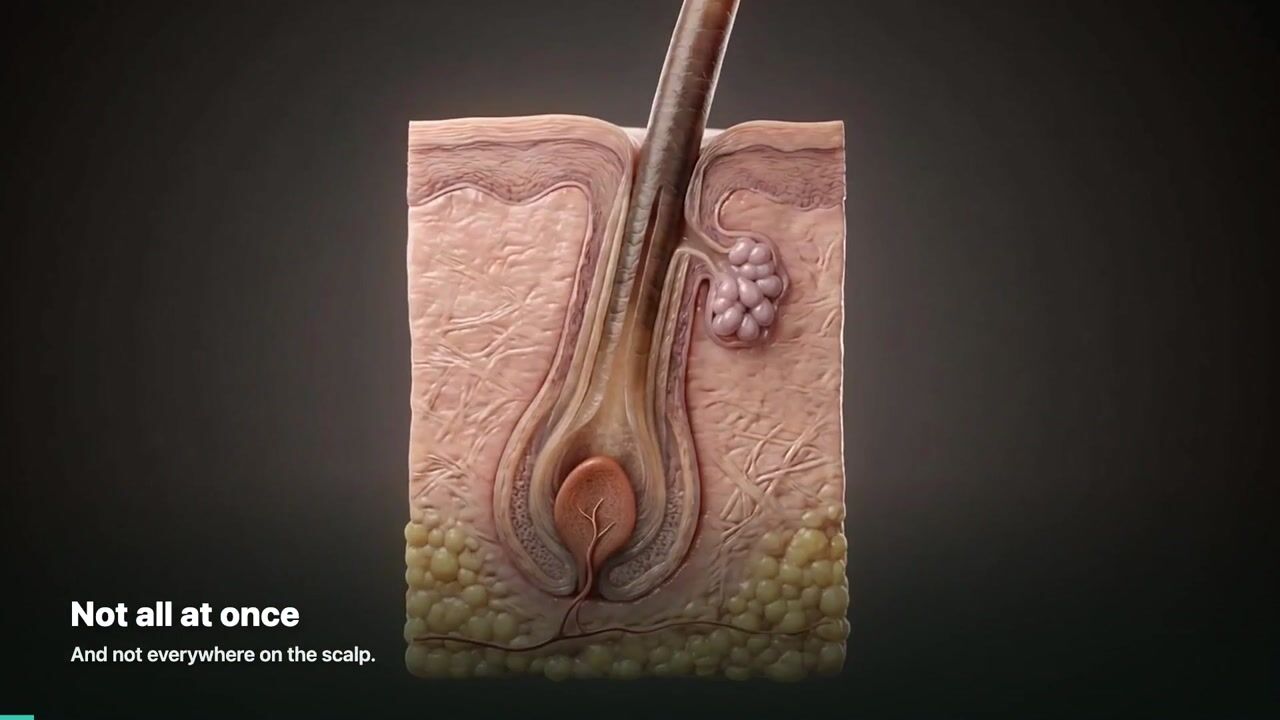
Every hair on your head grows from a tiny structure in your skin called a follicle. A cross-section shows what sits beneath the surface. A fact-checked 3D patient-education video — educational only, not medical advice.
See a mistake in this video? Report it →
Video Transcript
Every hair on your head grows from a tiny structure in your skin called a follicle. A cross-section shows what sits beneath the surface. At the base of the follicle is the dermal papilla. Its blood supply feeds the cells that build the hair. Those cells fill with keratin and harden as they push upward, so the hair you can see is no longer living tissue. Every follicle moves through a repeating cycle with three main phases. In anagen, the growing phase, the follicle is long and deep. Scalp hairs can stay here for several years. In catagen, a brief transition, growth stops and the lower follicle begins to shrink. In telogen, the resting phase, the hair sits shallow in a shortened follicle for a few months, then sheds as a new hair begins to grow. Your follicles cycle independently, which is why hair sheds a little at a time. Shedding roughly fifty to one hundred hairs a day is considered normal. This video is for general education only. It is not medical advice. Ask your doctor what's right for you.
More Understanding Hair Loss Videos
 1:00, 1 minutes 00 seconds
 1:00, 1 minutes 00 seconds
 1:00, 1 minutes 00 seconds
Want this video on your practice website?
License the full Hair Restoration Learning Center — one script tag, domain-locked, $97/mo or $599/yr.